tiktok
Logo

1SYNESSERATION: A NEW CONCEPT OF RELATIONAL CO-BEING

Synesseration: Introducing a New Concept of Relational Co-Being

2026-07-23

Rev. Michel Rouhana, PhD, Antonine Order


SYNESSERATION: A NEW CONCEPT OF RELATIONAL CO-BEING

Synesseration: Introducing a New Concept of Relational Co-Being

A Philosophical Neologism in Dialogue with Phenomenology, Process Metaphysics, and Intercultural Thought

Michel C. Rouhana, Antonin

Saint Joseph University

2026

Author Note

The Arabic concept التكاؤن (Attaka'on), the conceptual correlate of synesseration, has been registered with the Lebanese Ministry of Economy. All intellectual rights pertaining to this concept and its Arabic designation are reserved by the author. Correspondence regarding this article should be addressed to Michel C. Rouhana, Antonin. ORCID: https://orcid.org/0009-0008-3394-5795

SYNESSERATION: A NEW CONCEPT OF RELATIONAL CO-BEING

Synesseration: Introducing a New Concept of Relational Co-Being

A Philosophical Neologism in Dialogue with Phenomenology, Process Metaphysics, and Intercultural Thought

Michel C. Rouhana, Antonin

Saint Joseph University

2026

Author Note

The Arabic concept التكاؤن (Attaka'on), the conceptual correlate of synesseration, has been registered with the Lebanese Ministry of Economy. All intellectual rights pertaining to this concept and its Arabic designation are reserved by the author. Correspondence regarding this article should be addressed to Michel C. Rouhana, Antonin. ORCID: https://orcid.org/0009-0008-3394-5795


2SYNESSERATION: A NEW CONCEPT OF RELATIONAL CO-BEING

Abstract

This article introduces and formally defines synesseration, a philosophical neologism coined to name a specific mode of relational co-being that existing philosophical vocabulary has not adequately captured. The Arabic conceptual correlate, التكاؤن (Attaka'on), has been officially registered with the Lebanese Ministry of Economy, affirming the concept's cross-linguistic and cross-cultural philosophical reach. Synesseration is defined as a dynamic process of co-being in which individuals or groups enter into a shared modus vivendi through synergy, synchrony, and relational movement, preserving both unity and difference. The concept is situated within a rich philosophical lineage: it draws on Heidegger's (1962) structural account of Mitsein (Being-with), deepens it through Buber's (1970) dialogical I-Thou, integrates the ethical asymmetry of Levinas (1969, 1981), incorporates the processual ontology of Whitehead (1978), and grounds itself in Zubiri's (1980, 2003) notion of respectivity. Synesseration exhibits a triadic structure—synergy, synchrony, and relational movement—that generates three constitutive outcomes: unity without fusion, difference without separation, and movement without dissolution. The article argues that this concept carries significant ethical and intercultural implications, offering a new framework for understanding human togetherness in pluralist societies, conflict resolution, and organizational life. The article's contributions are threefold: philosophical precision in naming a new form of relational existence, linguistic analysis of the neologism's morphological foundations, and a demonstration of its applicability across diverse domains of human inquiry.

Keywords: synesseration, التكاؤن (Attaka'on), relational ontology, co-being, phenomenology, process metaphysics, intercultural dialogue, neologism


3SYNESSERATION: A NEW CONCEPT OF RELATIONAL CO-BEING

Lay Summary

Human beings have always lived alongside one another, but living alongside is not the same as living together. There is a profound difference between the mere fact of sharing space and time with others, and the richer, more dynamic experience of genuinely co-inhabiting a world—of building something together while remaining distinctly oneself. The new philosophical concept of synesseration names exactly this richer form of human togetherness. It describes a living process in which people or communities enter into a shared way of life through genuine synergy—creating together what none could create alone—through synchrony, a mutual attunement of rhythms and timing, and through relational movement, the capacity to grow and change without losing the bond that connects them. Synesseration is not assimilation, in which one party is absorbed into another; nor is it mere tolerance, in which parties simply coexist at a polite distance. It is active, generative, and transformative, preserving both the unity of "we" and the integrity of each distinct voice within it. The concept matters urgently for pluralist societies navigating cultural diversity, for communities seeking reconciliation, and for any human project that aims at genuine collaboration. The Arabic conceptual correlate, التكاؤن (Attaka'on), has been officially registered with the Lebanese Ministry of Economy, securing the concept's recognition within Arab intellectual and legal heritage.


4SYNESSERATION: A NEW CONCEPT OF RELATIONAL CO-BEING

Introduction

Contemporary life is marked by a paradox of proximity and estrangement. Globalisation, digital communication, and mass migration have placed human beings in unprecedented degrees of contact with one another, yet the philosophical and practical resources for understanding what it means to genuinely co-inhabit a world have not kept pace. Political communities fracture, intercultural encounters collapse into either forced assimilation or mutual indifference, and even intimate relationships struggle to articulate the lived structure of genuine togetherness. Philosophy has not lacked concepts of relation—from Heidegger's (1962) Mitsein to Buber's (1970) I-Thou, from Levinas's (1969) face-to-face to Nancy's (2000) être-avec—yet each of these, as will be argued in what follows, captures an important but partial dimension of the phenomenon this article seeks to name. What has been missing is a concept that integrates the processual, synergic, synchronous, and dynamically relational dimensions of human co-being into a single, philosophically precise term. This article proposes that the neologism synesseration—and its Arabic counterpart التكاؤن (Attaka'on), registered with the Lebanese Ministry of Economy—fills this conceptual lacuna.

The aims of this article are fourfold. First, it introduces and formally defines synesseration as a philosophical concept, providing an etymological and morphological analysis of the neologism. Second, it locates synesseration within the history of philosophical reflection on relation, situating it in dialogue with five major traditions: Heidegger's phenomenological ontology, Buber's dialogical philosophy, Levinas's ethics of alterity, Whitehead's process metaphysics, and Zubiri's relational metaphysics. Third, the article develops a detailed conceptual analysis of synesseration's triadic structure and its three constitutive outcomes. Fourth, it explores the implications of synesseration for phenomenology, ethics, political theory, intercultural dialogue, and organizational theory. The article proceeds in the following order: after this introduction, it offers an etymological and linguistic justification for the neologism; presents the canonical definition in three languages; conducts a structured literature review; develops the conceptual analysis; examines the Arabic dimension in depth; explores implications and applications; and concludes with a call for future research and a reflection on the philosophical significance of naming.

The interlocutors this article engages are not chosen arbitrarily. Heidegger's (1962) account of Dasein's constitutive Being-with provides the ontological horizon within which synesseration operates. Buber's (1970) philosophy of encounter furnishes the model of genuine relational transformation. Levinas's (1969, 1981) insistence on the ethical priority of the Other ensures that synesseration is not naively symmetrical but remains sensitive to asymmetries of vulnerability and responsibility. Whitehead's (1978) processual cosmology supplies the metaphysical framework within which becoming-together—rather than simply being-together—can be conceptualized. And Zubiri's (1980, 2003) notion of respectivity, the intrinsic relatedness that constitutes all realities, provides the ontological grounding from which the mutual constitution of synesseration participants can be understood.

A word must be said about why a new term is needed at all, rather than a nuanced repurposing of existing vocabulary. The philosophical lexicon is not impoverished; indeed, it may be charged with an excess of relational concepts. Yet each existing concept either captures only the static structure of co-being (Mitsein), or restricts genuine relation to the dyadic encounter (I-Thou), or emphasises one party's responsibility to the exclusion of mutuality (Levinas), or applies to cosmological rather than interpersonal scales (concrescence), or lacks the temporal and processual dimension that everyday human togetherness requires. Repurposing any of these terms would require so much qualification as to obscure rather than illuminate. Coining a new term is, in this case, not an act of conceptual inflation but of philosophical precision: it names something real that existing language has left in the shadows. The claim, then, is modest but rigorous—synesseration names a phenomenon that merits its own conceptual home.

Finally, the bilingual (and indeed trilingual) character of this article—engaging the concept in English, Arabic, and French—is itself philosophically significant. Synesseration, as a concept, insists that genuine co-being cannot be the monopoly of any single cultural or linguistic tradition. The registration of التكاؤن (Attaka'on) with the Lebanese Ministry of Economy is not merely a legal formality; it is a philosophical statement that the concept belongs to a shared human intellectual heritage, and that its Arabic formulation carries depths of meaning that the Greek-Latin construction of synesseration both complements and needs. This intercultural dimension will be explored in detail in Section 9.


5SYNESSERATION: A NEW CONCEPT OF RELATIONAL CO-BEING

Etymology and Linguistic Justification

The neologism synesseration is a deliberate morphological construction that draws on Greek and Latin roots to encode its philosophical meaning at the level of form. Unpacking its components reveals why no existing term achieves the same conceptual economy.

The prefix syn-, derived from the Greek σύν, carries the meanings of together, with, and co-. Crucially, however, the Greek σύν does not denote mere aggregation or spatial proximity; it implies a union that preserves the identity of what is brought together. This is visible in such compounds as σύνθεσις (synthesis: a putting-together that produces a new unity without abolishing the constituent elements) and συμφωνία (symphonia: a sounding-together that requires distinct voices). The choice of syn- rather than, say, con- (Latin: with) is philosophically motivated: syn- better captures the active, generative quality of the relation in question, its character as an event of co-production rather than a static state of co-presence.

The central morpheme -ess- derives from the Latin esse, the infinitive of the verb "to be." This is the same root from which "essence," "essential," and "essentiality" are drawn. In the construction of synesseration, -esse- functions to introduce the dimension of being: what is at stake in synesseration is not merely joint activity or shared affect, but a shared mode of being, a co-constitution of existence itself. The phonological softening to -ess- within the compound also echoes the term essence, recalling the classical philosophical question of what something fundamentally is—inviting the reading that synesseration concerns the essence of relational being. The intermediate form esseration, coined for this construction, may be understood as naming the act or process of being-as-such, the bringing of being into dynamic expression.

The nominalizing suffix -ation is among the most productive in English philosophical vocabulary, denoting process, ongoing action, and dynamic condition rather than static state. Compare: concrescence (Whitehead), individuation (Simondon), alienation (Marx, Hegel). The suffix ensures that synesseration is understood as a process—something that is always happening, always in motion—rather than a property or a fixed structure.

The compound as a whole, then, encodes the following philosophical claim: synesseration is the ongoing (‑ation) process of being-together (syn‑ + esse‑) as a dynamic co-constitution. No existing term achieves this combination. "Coexistence" is merely spatial. "Communion" carries theological connotations of fusion that efface difference. "Solidarity" emphasises shared commitment but not the ontological dimension of co-being. "Togetherness" is too informal to bear philosophical weight.

The verb to synesserate follows standard English morphological patterns for denominal verbs. Its conjugation is regular: in the first person singular, "I synesserate"; in the first person plural, "we synesserate"; in the progressive aspect, "they are synesseration" or "the process of synesseration is underway"; in the past participle, "synesserated." The adjectival forms are synesserate (present: "a synesserate community") and synesserated (past: "a synesserated relation"). This flexibility across grammatical categories—noun, verb, adjective, gerund—confirms the concept's linguistic productivity and its capacity to generate a family of related expressions.

The formation of synesseration invites comparison with other celebrated philosophical neologisms. Heidegger's (1962) Dasein (da: there + sein: being) encodes the situatedness of human existence at the morphological level. Levinas's coinage illeity (from the Latin ille: that one, the third person) names the absolute alterity of the Other beyond the face. Whitehead's (1978) concrescence (from the Latin concrescere: to grow together) names the process by which an actual occasion integrates its data into a unified experience. Each of these neologisms does philosophical work that no pre-existing term could do as precisely. Synesseration belongs to this tradition of conceptual coinage as philosophical necessity.

The Arabic التكاؤن (Attaka'on) is constructed on the root ك-و-ن (K-W-N), which is the Arabic triconsonantal root for being, existence, and becoming—the deepest stratum of ontological vocabulary in the Arabic language. The form تكاؤن belongs to the tafā'ul morphological pattern (تفاعل), which in Arabic grammar denotes reciprocal, mutual, or intersubjective action. The letter ت at the beginning of the form signals reflexivity and mutuality; the ا in the middle signals extension and duration. The registration of this term with the Lebanese Ministry of Economy affirms its status not only as a philosophical concept but as a protected element of Arabic intellectual heritage.


6SYNESSERATION: A NEW CONCEPT OF RELATIONAL CO-BEING

Canonical Definition

Synesseration (n.): "A dynamic process of co‑being in which individuals or groups enter into a shared modus vivendi through synergy, synchrony, and relational movement, preserving both unity and difference."

Arabic (التكاؤن / Attaka'on): "مسار ديناميكي للتكاؤن تدخل فيه الأفراد أو الجماعات إلى نمط حياة مشترك من خلال التآزر والتزامن والحركة العلائقية، مع الحفاظ على الوحدة والاختلاف معًا."

French (La synessération): "Un processus dynamique de co-être dans lequel des individus ou des groupes entrent dans un modus vivendi partagé par la synergie, la synchronie et le mouvement relationnel, en préservant à la fois l'unité et la différence."

The canonical definition above condenses a philosophical vision that merits elaboration in each of the three languages it inhabits. The following paragraphs develop this elaboration, first in Arabic, then in French, in order to honor the concept's intercultural architecture.

Arabic Explanatory Paragraph

التكاؤن (Attaka'on) ليس مجرد تعايش سلبي أو تساكن ظرفي، بل هو مسار نشط وديناميكي تُبنى فيه العلاقة الإنسانية بوصفها حدثاً متجدداً ومتحوّلاً. ففي التكاؤن، لا تتلاشى هوية الفرد في هوية الجماعة، ولا تنفصل الجماعة إلى ذرات متنافرة؛ بل تُصان الوحدة والاختلاف معاً في توتر خلّاق ومُثمر. وبهذا المعنى، يُشكّل التكاؤن إطاراً فلسفياً جديداً لفهم معنى العيش المشترك في عالمٍ تتعدد فيه الثقافات والهويات والرؤى. إنه ليس إدماجاً يمحو التنوع، ولا مجرد تسامح يُبقيه على مسافة آمنة، بل هو التقاء فاعل يُنتج معنى مشتركاً لم يكن ممكناً لأي طرف منفرداً. وقد جرى تسجيل مفهوم التكاؤن لدى وزارة الاقتصاد اللبنانية، مما يُكرّس حقوقه الفكرية ويُثبّت حضوره في الإرث الفلسفي العربي، ويؤكد على أن الفلسفة ليست ملكاً لحضارة دون أخرى، بل هي مشروع إنساني مشترك يُغني كل لسانٍ الآخر ويُعمّق دلالاته.

French Explanatory Paragraph

La synessération ne saurait être réduite à une simple coexistence ou à un voisinage de fait. Elle désigne un processus actif et dynamique par lequel des individus ou des groupes construisent ensemble un mode d'être partagé, sans pour autant se dissoudre les uns dans les autres ni se replier dans une séparation stérile. En ce sens, la synessération constitue un cadre philosophique inédit pour penser la vie commune dans des sociétés marquées par la pluralité des cultures, des histoires et des visions du monde. Elle n'est ni une assimilation qui effacerait la différence, ni une tolérance qui la maintiendrait à distance respectueuse, mais une rencontre génératrice qui produit quelque chose d'entièrement nouveau — une réalité relationnelle qui n'aurait pu naître d'aucun des partenaires pris isolément. La synessération exige donc une posture éthique et une disponibilité à l'altérité qui sont, en même temps, une fidélité à soi-même. Ce double mouvement — vers l'autre et vers soi — est l'essence même du processus qu'elle nomme, et c'est précisément cette tension créatrice qu'aucun terme existant n'avait encore su nommer avec une telle précision philosophique.


7SYNESSERATION: A NEW CONCEPT OF RELATIONAL CO-BEING

Literature Review

7.1 Heidegger's Mitsein (Being-with)

Martin Heidegger's (1962) analysis of Dasein in Being and Time constitutes the unavoidable starting point for any philosophical account of human co-being. In his systematic destruction of Cartesian subjectivism, Heidegger argued that Dasein—human existence as the being for whom Being is a question—is never a self-enclosed monad that subsequently enters into relation with others. Rather, Being-with (Mitsein) is a fundamental existential structure of Dasein: to be at all is already to be in a world that is constitutively shaped by the presence of others. The world is always already a shared world (Mitwelt), and the others who populate it are not objects encountered among other objects but co-Daseins whose existence is co-constitutive of one's own.

This is a profound and enduring philosophical insight, and synesseration is built upon it rather than against it. However, Mitsein as Heidegger articulates it operates primarily as an ontological background condition—a structural feature of Dasein's constitution—rather than as an active, dynamic process that requires cultivation, effort, and mutual engagement. Heidegger's account of everyday Being-with tends, moreover, toward the impersonal mode of das Man (the "they"), in which Dasein is absorbed into anonymous public existence rather than genuinely relating to specific others in their particularity (Heidegger, 1962). The critical distinction, therefore, is as follows: Mitsein names the ontological condition of possibility for human togetherness, but it does not account for the active relational movement through which individuals or communities genuinely co-create a shared modus vivendi. Synesseration names precisely this active process—the movement from the mere structural fact of Being-with toward a lived, dynamic, and generative co-being that requires and produces something new.

7.2 Buber's Ich-Du (I-Thou)

Martin Buber's (1970) I and Thou represents perhaps the most celebrated philosophical account of genuine relational encounter in the Western tradition. Buber distinguished two fundamental attitudes toward the world: the I-It relation, in which the other is treated as an object of use, experience, or analysis; and the I-Thou relation, in which the other is encountered as a genuine subject, a presence that speaks and is addressed, transforming both parties in the encounter. The I-Thou is not a static connection but an event—a moment of genuine meeting (Begegnung) in which both self and other are constituted anew through their encounter. Crucially, Buber (1970) insisted that the I-Thou relation is not an achievement of will or technique but a grace: it happens, and it passes, leaving its trace in the I that now carries within it the memory of genuine encounter.

Synesseration is deeply indebted to Buber's vision of genuine encounter as transformative and mutual. However, the I-Thou as Buber develops it is paradigmatically dyadic: it concerns the meeting of one I and one Thou in a moment of full presence. Synesseration extends this model in at least two significant directions. First, it scales the logic of genuine encounter to groups, communities, and intercultural configurations—spaces in which the relational dynamics cannot be captured by the dyadic model alone. Second, synesseration introduces structural dimensions—synergy, synchrony, and relational movement—that account for the ongoing, processual character of genuine co-being beyond the privileged but necessarily transient moment of I-Thou encounter. The relation described by synesseration is not a series of discrete moments of meeting but an evolving, temporally extended process in which the dimensions of synergy and synchrony sustain and deepen the relation over time.

7.3 Levinas and the Ethics of the Other

Emmanuel Levinas's philosophical project, articulated across Totality and Infinity (1969) and Otherwise Than Being, or Beyond Essence (1981), effects a radical reorientation of philosophical priority: instead of asking what it means to be (ontology), Levinas asks what it means to be responsible—and argues that ethics, understood as the infinite responsibility to the Other, is first philosophy. The face of the Other (le visage d'autrui) calls me to responsibility before I have had the opportunity to choose; the Other's vulnerability, mortality, and need constitute a claim upon me that precedes any contract, any reciprocity, any symmetry. This ethical asymmetry—the Other's claim on me is not conditioned by my claim on the Other—is, for Levinas, the foundation of genuine human sociality.

Synesseration incorporates and preserves this Levinasian insight. Any account of genuine co-being that collapses into a comfortable symmetry risks what Levinas (1969) called the violence of "totality"—the subsumption of the Other's irreducible alterity into a system that the self comprehends and controls. Synesseration's constitutive outcome of "difference without separation" is in part a Levinasian inheritance: the Other's difference is not a problem to be resolved but a condition to be honored. Nevertheless, synesseration parts ways with Levinas in an important respect. Levinas's account, for all its ethical richness, tends to describe the relation between self and Other in terms of the self's one-sided obligation—the face that calls and the I that responds—rather than in terms of a mutual, generative process in which both parties are transformed and a shared world is co-created. Synesseration integrates Levinasian ethical asymmetry within a broader account of mutuality: the responsibility to the Other is the ethical motor of synesseration, but the process it drives is one of shared becoming, of movement toward a modus vivendi that honors the Other's alterity without abandoning the possibility of genuine unity.

7.4 Whitehead's Process Metaphysics

Alfred North Whitehead's (1978) magnum opus, Process and Reality, offers a cosmological vision in which the fundamental units of reality are not substances but events—"actual occasions" or "actual entities"—each of which is constituted through a process of "concrescence," the integration of data from the surrounding universe into a novel, unified experience. For Whitehead, reality is irreducibly social: actual occasions are constituted by their relations to other actual occasions, and the universe is a vast, interlocking community of such occasions, each prehending and being prehended by others. The social categories of Whitehead's ontology—"societies" of actual occasions, "nexūs," "enduring objects"—describe the various structures through which occasions of experience are organized into the ordered patterns that constitute the world as experienced.

Synesseration draws extensively on the processual and social dimensions of Whitehead's cosmology. The insistence that co-being is always a process of becoming—never a completed state—is directly Whiteheadian in inspiration. The concept of "relational movement" within synesseration's triadic structure is an application of concrescence's temporal dynamics to the specifically interpersonal and intercultural domain. However, Whitehead's account operates at a cosmological scale—actual occasions of experience are not persons or communities but micro-events at the most fundamental level of reality—and thus requires significant transposition before it can illuminate human co-being. Synesseration performs this transposition: it takes Whitehead's insight that all existence is constitutively relational and processual, and applies it at the scale of human beings, groups, and cultures, yielding a concept that is metaphysically grounded in process thought but phenomenologically scaled to lived experience.

7.5 Zubiri's Relational Metaphysics

Xavier Zubiri, the Spanish philosopher whose work has only recently begun to receive the international recognition it deserves, developed a relational metaphysics centred on the concept of respectividad (respectivity)—the intrinsic relatedness of all realities (Zubiri, 1980, 2003). For Zubiri, things are not first constituted as independent substances that subsequently enter into external relations; rather, reality is fundamentally respective—each real thing is what it is in virtue of its intrinsic openness to other realities. This is not a merely logical or epistemological claim but an ontological one: the very structure of the real is relational. In his later work, Zubiri (2003) developed this insight into a dynamic account of reality in which the "dynamic structure" of things is to be understood in terms of their self-giving (dar de sí)—the capacity of real things to give of themselves in relation to other realities, generating novelty and transformation.

Zubiri's respectivity provides synesseration with an important ontological foundation. If reality is intrinsically respective—if things are constituted in and through their relations—then synesseration is not an optional add-on to human existence but a mode of realizing what human beings fundamentally are: relational beings whose reality is given, deepened, and transformed through their relations with others. However, Zubiri's metaphysics, for all its relational richness, does not focus specifically on the temporal dynamics of human co-becoming or on the ethical and cultural dimensions of relational life. Synesseration adds to Zubiri's relational ontology a specific account of the temporal structure (synchrony), the productive dimension (synergy), and the ethical horizon (difference without separation) of genuine human co-being.

7.6 Contemporary Relational Metaphysics and Social Ontology

The late twentieth and early twenty-first centuries have witnessed a broad "relational turn" across multiple philosophical and social-scientific disciplines, generating a rich body of work that synesseration both engages and extends. Jean-Luc Nancy's (2000) concept of être-avec (being-with) in Being Singular Plural developed Heidegger's Mitsein in a more explicitly political direction, arguing that the "with" is not supplementary to Being but is its primary structure: to be is to be-with, and the political community (community of those who have nothing in common, as Nancy provocatively formulated it) is grounded in this original with-structure. Nancy's account of singular plurality—the idea that each singular existence is always already multiple, always already shared—resonates deeply with synesseration's insistence on unity without fusion and difference without separation.

Virginia Held's (2006) ethics of care, developed in The Ethics of Care: Personal, Political, and Global, offers another important interlocutor. Held's care ethics foregrounds the relational, interdependent character of human life against liberal individualism's fiction of the autonomous self, and argues that the values of care—attentiveness, responsibility, competence, responsiveness—should be extended from the personal sphere to the political and global. This resonates with synesseration's ethical implications, though synesseration differs from care ethics in its emphasis on the mutual and co-generative character of the relation rather than on the directional movement of care from caregiver to care-recipient. In social ontology, relational approaches have been advanced across sociology (Crossley, 2011), philosophy of mind (De Jaegher & Di Paolo, 2007), and feminist philosophy (Mackenzie & Stoljar, 2000), each contributing to a broad theoretical context within which synesseration can be located and distinguished. Synesseration synthesizes and extends these traditions by providing a unified conceptual framework—grounded in rigorous etymological construction, a triadic structural analysis, and a rich philosophical genealogy—that none of these approaches, taken individually, provides.


8SYNESSERATION: A NEW CONCEPT OF RELATIONAL CO-BEING

Conceptual Analysis: The Triadic Structure of Synesseration

8.1 The Three Dimensions of Syn

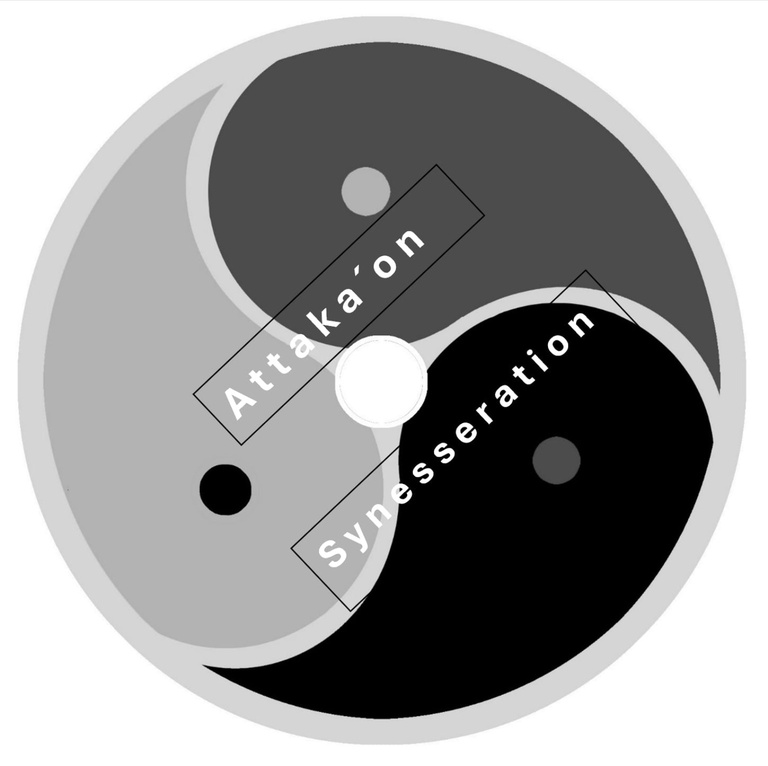
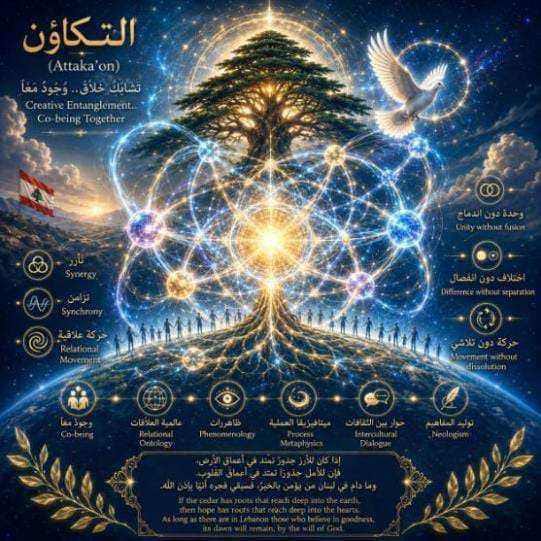
The prefix syn- generates, within synesseration's conceptual architecture, three analytically distinguishable but experientially intertwined dimensions: synergy, synchrony, and relational movement. Each of these dimensions names a distinct aspect of the process of co-being; together, they constitute the full texture of synesseration as a lived relational phenomenon.

Synergy (from the Greek σύν + ἔργον: together-work) names the co-productive dimension of synesseration—the capacity of genuine relational encounter to generate outcomes, meanings, and realities that neither party could have produced alone. In its ordinary usage, synergy has been diluted by management discourse into a generic term for the combination of resources or efforts. In its philosophical rehabilitation within synesseration, synergy recovers its original force: it names a specifically relational creativity, a bringing-forth that is irreducibly joint. Synergy in this sense is not addition (one plus one equals two) but multiplication or even transcendence (one plus one equals something categorically new). It is the reason why genuine human encounters—artistic collaborations, philosophical dialogues, intercultural exchanges—produce something that cannot be derived from the sum of the parties' individual contributions. Synergy, so understood, is the generative core of synesseration: it is what makes co-being genuinely productive rather than merely associative.

Synchrony (from the Greek σύν + χρόνος: together-time) names the temporal attunement dimension—the shared rhythm and mutual timing that sustains a relation across time. It may be argued that synchrony is among the most under-theorized dimensions of human togetherness in the philosophical tradition. Phenomenological accounts of temporality (Husserl's inner time-consciousness, Heidegger's ecstatic temporality) have focused primarily on the structure of individual temporal experience; the question of how two or more temporal streams come to be attuned to one another—how persons or communities develop shared rhythms of attention, response, and initiative—has been largely left to psychology and developmental science (e.g., Stern, 2004). Within synesseration, synchrony is not mere simultaneity (being at the same time) or coordination (acting at the same time according to an external plan) but a deeper attunement: a mutual calibration of temporal horizons in which each party's sense of pace, timing, and duration is shaped by and shapes the other's. This temporal dimension is what allows synesseration to be not merely a series of encounters but an enduring relational process.

Relational movement names the dynamic, non-static character of synesseration as a whole—the ontological claim that co-being is always becoming, never a settled state. Drawing on Whitehead's (1978) processual ontology and Zubiri's (2003) concept of the self-giving of the real, relational movement asserts that a genuine relation is not a fixed connection between pre-constituted entities but an ongoing event in which the parties are themselves transformed by the very act of co-being. To synesserate is not to occupy a stable relational position but to be in motion—to be changed, deepened, challenged, and renewed by one's encounter with the other. This dimension of synesseration resists any static or reifying account of human togetherness and insists on the fundamentally temporal and processual character of all genuine co-being.

8.2 The Three Outcomes

Corresponding to the three dimensions of synesseration are three constitutive outcomes—relational achievements that distinguish synesseration from other, lesser forms of human togetherness. These outcomes are not external goals to be aimed at but intrinsic features of the synesseration process itself: where synesseration genuinely occurs, these outcomes are always already in play.

Unity without fusion names the achievement of a genuine "we"—a collective identity, a shared modus vivendi, a common world—that does not require the erasure of individual or group particularity. The danger of unity, as Levinas (1969) recognised, is totalization: the subsumption of the Other's irreducible difference into a system that the self (or the dominant group) comprehends and controls. Synesseration's unity without fusion insists that the "we" it generates is constitutively plural—that its unity is the unity of a chord rather than a unison: a harmony of distinct voices rather than their reduction to a single note. This is a demanding relational achievement, for it requires holding together the centripetal pull toward unity and the centrifugal pull toward distinction without collapsing into either extreme.

Difference without separation is the complementary outcome: the preservation of genuine otherness—of cultural, personal, and experiential difference—within the context of a shared relational life. Difference without separation asserts that alterity need not entail alienation, that the recognition and affirmation of what distinguishes us need not rupture the bond that connects us. This outcome is the relational analog of biodiversity in ecological thought: a rich, varied, and therefore resilient form of co-being that draws strength precisely from its internal differentiation. The failure mode to be avoided here is not fusion but estrangement—the hardening of difference into opposition, the retreat from genuine encounter into parallel existence.

Movement without dissolution names the dynamic dimension of synesseration's outcomes: the capacity of a genuine relation to grow, change, and evolve—to incorporate new experiences, new challenges, and new parties—without losing its coherence or integrity. All genuine human relations must change over time; stasis is not stability but stagnation. Yet change, if it proceeds without awareness or intentionality, can dissolve the relation entirely—eroding the shared world, the mutual rhythms, the co-created meanings that constitute the relation's identity. Movement without dissolution describes the capacity to navigate this tension: to grow together while remaining genuinely together.

8.3 The Verb "To Synesserate" — Pragmatic Uses

The verb to synesserate gains its philosophical weight from being grounded in lived human situations. Three case studies are offered here to illustrate the concept's pragmatic application across different scales of human life.

Case Study A — The Couple

Two partners who synesserate over time develop shared rhythms, creative co-productivity, and a relational identity that preserves each person's individuality. Their synesseration is visible in the unique "third space" of the relationship—neither hers nor his but theirs—a space constituted by shared language, shared history, shared aesthetic sensibilities, and shared projects that neither partner could have generated alone. The couple's synesseration is manifested in the synchrony of their daily routines and emotional attunements, in the synergy of their collaborative endeavours (intellectual, artistic, domestic, or otherwise), and in their shared capacity for relational movement—for navigating conflict, loss, growth, and change while remaining genuinely committed to one another's irreducible difference. The failure of synesseration in a couple typically takes one of two forms: fusion (the loss of individual identity through over-identification with the partner) or separation (the hardening of individual boundaries into barriers against genuine encounter). Synesseration names the difficult but achievable third path between these failure modes.

Case Study B — The Interdisciplinary Research Team

A research team synesserates when its members' distinct expertise enters genuine synergy: not merely parallel contribution, in which each specialist produces their portion of the work in isolation, but mutual attunement and co-generation of ideas that transform each member's perspective while producing a unified intellectual output. Such a team is synesserated when a philosopher's conceptual vocabulary is reshaped by engagement with an empirical scientist's data, when a social scientist's analytical frameworks are deepened by a humanist's attention to narrative and meaning, and when all parties discover that their collaborative output is not the mechanical sum of their individual contributions but a genuinely new creation that none could have achieved alone. The synchrony of such a team is visible in the calibration of its communicative rhythms—the pacing of meetings, the responsiveness of email exchanges, the shared sense of when to push and when to wait—and in the mutual temporal investment that sustains the collaboration across the interruptions and competing demands of academic life.

Case Study C — The Intercultural Community

A neighbourhood of culturally diverse residents synesserates when shared public rituals, civic projects, and everyday encounters produce a community culture that holds diversity and unity simultaneously without forcing assimilation or tolerating mere indifference. Such a community is not a melting pot, in which differences are dissolved into a homogeneous whole; nor is it a mosaic, in which distinct pieces coexist without genuine interaction. It is something more dynamic: a living process in which the diverse cultural traditions, languages, practices, and memories of its residents enter into genuine relational movement, producing a shared civic identity that is constitutively plural. The synchrony of such a community is visible in its shared temporal rhythms—shared public celebrations, shared spaces of encounter, shared rhythms of neighborhood life—that create the conditions for genuine synergy: the co-production of a neighborhood culture richer and more vital than any single constituent tradition could have generated alone.


9SYNESSERATION: A NEW CONCEPT OF RELATIONAL CO-BEING

Synesseration and التكاؤن (Attaka'on): The Arabic Dimension

The Arabic concept التكاؤن (Attaka'on) is not a mere translation of synesseration but a philosophically independent formulation that draws on resources of the Arabic language and its philosophical traditions to articulate the same fundamental insight from a different cultural and linguistic horizon. Understanding the depth of the Arabic formulation is essential both to appreciating the concept's intercultural architecture and to recognizing the philosophical significance of its registration with the Lebanese Ministry of Economy.

The triconsonantal root ك-و-ن (K-W-N) is, in Arabic, the root of being, existence, and becoming. It generates كَوْن (kawn: cosmos, universe), كَائِن (kā'in: existing being, entity), كَيْنُونَة (kaynūna: beingness, existence as such), and مَكَان (makān: place—literally, the site of being). To build a philosophical neologism on this root is to anchor it in the deepest stratum of Arabic ontological vocabulary—the layer that Arabic philosophical tradition (falsafa) has always recognized as the foundation of all inquiry. The prefix تَـ and the internal ا of the تكاؤن form constitute, as noted above, the tafā'ul morphological pattern—the pattern of reciprocal or mutual action in Arabic grammar. This pattern is well established in Arabic for naming processes that are inherently intersubjective: تَعَاوَن (ta'āwun: mutual cooperation), تَفَاهُم (tafāhum: mutual understanding), تَوَاصُل (tawāṣul: mutual communication). By deploying this pattern, التكاؤن encodes, at the grammatical level, the reciprocal and mutual character of the process it names: it is not simply "being" but "mutual co-becoming"—a being-with that is at the same time a becoming-with.

The Arabic philosophical and cultural tradition offers additional resonances that enrich the concept. The Islamic philosophical tradition's long engagement with the tension between waḥda (unity, oneness) and kathāra (multiplicity) finds in التكاؤن a new conceptual instrument for navigating this ancient dialectic. The Sufi tradition's concept of waḥdat al-wujūd (the unity of being, associated with Ibn ʿArabī) and its critics' insistence on the irreducible multiplicity of created beings are both honoured within التكاؤن's structure: it names a unity that does not erase multiplicity, and a multiplicity that does not dissolve into mere dispersion. Similarly, the Arab philosophical tradition's engagement with the concept of ʿalāqa (relation, connection)—present in the Aristotelian commentaries of al-Fārābī, Ibn Sīnā, and Ibn Rushd—provides a rich conceptual heritage within which التكاؤن can be located.

The registration of التكاؤن (Attaka'on) with the Lebanese Ministry of Economy is an act with multiple philosophical and legal dimensions. Legally, it secures the intellectual rights of the author over the concept's Arabic formulation, ensuring that its use in academic, educational, and public contexts is properly attributed. Philosophically, it affirms that philosophical concepts can and should be recognized as forms of intellectual and cultural property deserving of formal protection—a proposition that has important implications for the integrity of philosophical authorship in an era of rapid and often uncredited dissemination of ideas. Culturally, the registration affirms that the Arabic-speaking world has a stake in the global philosophical conversation—not merely as a recipient of concepts forged in European or Anglophone traditions, but as a co-creator of new conceptual frameworks that enrich and transform that conversation. In this sense, التكاؤن's registration is itself an act of synesseration: it insists that the concept belongs to a shared philosophical heritage that neither absorbs nor segregates its diverse contributions.


10SYNESSERATION: A NEW CONCEPT OF RELATIONAL CO-BEING

Implications and Applications

10.1 Phenomenology

Within the phenomenological tradition, synesseration opens a third path between two inadequate poles: solipsism (the reduction of experience to the first-person singular) and absorption into the collective (the dissolution of individual experience into an undifferentiated "we"). Classical phenomenology, from Husserl's transcendental ego to Sartre's conflictual account of the Other (pour-autrui), has struggled to give adequate philosophical expression to the first-person plural—the "we" of genuine shared experience—without either reducing it to a sum of individual first-person perspectives or positing a collective subject that effaces individuality. Synesseration proposes that genuine co-being is phenomenologically irreducible: the experience of synesseration is not the experience of my individual perspective plus another's individual perspective, but a qualitatively distinct mode of experience—a first-person plural phenomenology that has its own structure, its own temporal dynamics, and its own forms of evidence. This opens productive research directions for phenomenological inquiry into shared experience, collective intentionality (Searle, 1990; Tuomela, 2007), and the phenomenology of intercultural encounter.

10.2 Process Metaphysics

Synesseration may be understood, within Whitehead's (1978) processual framework, as a human-scale instantiation of concrescence—the process by which actual occasions integrate their data into a unified, novel experience. At the human scale, what is being integrated is not merely causal efficacy from the surrounding universe but the full richness of another person's or community's existence: their history, their culture, their temporal rhythms, their creative potentials. Synesseration is, in this sense, a macro-scale concrescence: a process by which human beings and communities achieve novel unification without losing the real diversity of what they have prehended. This framing suggests that process metaphysics, far from being confined to cosmological speculation, has direct implications for understanding the dynamics of human co-becoming—and that synesseration provides the conceptual bridge between Whitehead's cosmology and the phenomenology of lived relational life. Future work might develop a process-relational account of political community, cultural creativity, and organizational life grounded in synesseration's conceptual framework.

10.3 Ethics

Synesseration has significant ethical implications that extend and integrate contributions from both Levinasian and Buberian traditions. From Levinas (1969, 1981), synesseration inherits the insistence that genuine relation is always already ethically charged: the Other's face is not a problem to be solved but a call to which I am obligated before any deliberate choice. This ethical priority of the Other is preserved in synesseration's constitutive outcome of "difference without separation"—the requirement to honor the Other's alterity within the context of the shared relation. From Buber (1970), synesseration inherits the vision of relational transformation: genuine encounter is not ethically neutral but is itself a moral achievement, a choosing of the Thou over the It. Integrating these contributions, synesseration generates what may be called a relational ethics: an ethical framework in which the primary moral category is neither the isolated autonomous agent nor the abstract universal principle, but the living relational process in which selves and others are mutually constituted and mutually responsible. The ethical imperative that synesseration implies is not merely "do no harm to the Other" (Levinas) or "be genuinely present to the Other" (Buber) but the more demanding "co-create with the Other a shared world that honors both your unity and your difference."

10.4 Political Theory

Contemporary political theory has struggled to articulate a vision of pluralist democracy that moves beyond the liberal model of tolerance—in which different groups are granted the right to maintain their differences as long as they do not violate the rights of others—toward a richer account of genuine political co-being. Synesseration offers precisely such a vision. A synesserated political community is one in which cultural, ethnic, religious, and ideological differences are not merely tolerated but actively engaged—in which the diversity of its members is understood as a resource for collective creativity rather than a threat to social cohesion. This vision resonates with, but extends beyond, the multiculturalism debates of the 1990s and 2000s (Kymlicka, 1995; Taylor, 1994): where multiculturalism focused primarily on the recognition and accommodation of group difference within a liberal framework, synesseration focuses on the active relational process through which diverse groups co-create a shared political culture. The three outcomes of synesseration—unity without fusion, difference without separation, movement without dissolution—map onto the key challenges of pluralist democracy: the challenge of building a shared civic identity (unity without fusion), the challenge of maintaining genuine respect for minority cultures and identities (difference without separation), and the challenge of managing social change in ways that strengthen rather than dissolve democratic community (movement without dissolution).

10.5 Intercultural Dialogue and Conflict Resolution

The concept of synesseration has particularly promising applications in the contexts of intercultural dialogue and conflict resolution. Contemporary conflict resolution practice has increasingly recognized that sustainable peace requires more than the cessation of hostilities or the negotiation of formal agreements; it requires the construction of new relational structures between previously antagonistic parties—structures capable of generating genuine co-being rather than mere coexistence. Synesseration's triadic structure maps productively onto the stages of conflict resolution: the initial stage of ceasefire or separation (preserving difference without separation), the intermediate stage of dialogue and confidence-building (beginning to develop synchrony), and the advanced stage of joint projects and co-creation (achieving synergy and relational movement). The concept's insistence on unity without fusion is especially relevant in post-conflict contexts, where the danger of a peace that imposes uniformity (victor's peace) is as real as the danger of a peace that merely papers over unresolved antagonisms (cold peace). Synesseration names the kind of peace that is genuinely worth having: a living, dynamic, and generative co-being that honors the histories and identities of all parties while opening toward a shared future.

10.6 Organizational Theory

Within organizational theory and management studies, synesseration offers a distinctive model of high-functioning collaborative work that complements and extends existing frameworks. The literature on team effectiveness has long recognized that high-performing teams are characterized by more than efficient coordination or the complementarity of members' skills; they exhibit a kind of relational quality—variously described as team cohesion, psychological safety, or collective intelligence—that enables them to produce outputs qualitatively superior to what any individual member could produce (Hackman, 2002; Edmondson, 1999). Synesseration provides a philosophically grounded conceptual framework for this phenomenon: a high-functioning team is one that has achieved synesseration—that has developed genuine synergy in its creative processes, genuine synchrony in its temporal rhythms, and genuine relational movement in its capacity to grow and adapt. The practical implications of this framework are significant: organizational development, leadership training, and team design can be oriented not merely toward optimizing coordination but toward cultivating the conditions of synesseration—the mutual attunement, the trust in difference, the shared openness to transformation—that genuine collaborative co-being requires.


11SYNESSERATION: A NEW CONCEPT OF RELATIONAL CO-BEING

Conclusion

This article has introduced synesseration as a new philosophical concept with a distinctive claim on the attention of scholars in phenomenology, process metaphysics, ethics, political theory, intercultural studies, and organizational theory. The concept has been defended on etymological, morphological, and philosophical grounds: it names a form of relational co-being that existing philosophical vocabulary—from Heidegger's Mitsein to Buber's I-Thou, from Levinas's face-to-face to Whitehead's concrescence, from Zubiri's respectivity to Nancy's être-avec—approaches but does not fully capture. Its triadic structure (synergy, synchrony, relational movement) and its three constitutive outcomes (unity without fusion, difference without separation, movement without dissolution) provide a framework that is both philosophically precise and practically applicable.

The concept's unique position at the intersection of phenomenology, process thought, and intercultural philosophy is not accidental. It reflects the conviction that the most urgent philosophical challenges of the present moment—the challenge of pluralist coexistence, the challenge of intercultural dialogue, the challenge of collaborative creativity in a fragmented world—cannot be adequately addressed from within any single philosophical tradition. Synesseration is constitutively intercultural in its formation: the Arabic التكاؤن (Attaka'on), grounded in the ontological richness of the K-W-N root and the grammatical logic of the tafā'ul pattern, is not a translation of the Greek-Latin synesseration but its genuine conceptual partner, enriching and being enriched by the encounter.

Future research in several directions is warranted. Empirical studies—in social psychology, developmental science, and organizational behavior—could test and refine the conceptual distinctions introduced here, developing operationalizable measures of synergy, synchrony, and relational movement as dimensions of human co-being. Further linguistic study, across languages including Chinese, Hebrew, Swahili, and indigenous languages of the Americas, could explore whether and how the phenomenon of synesseration is captured, named, or nuanced in other linguistic traditions—potentially enriching the concept's conceptual architecture in ways that the present article, grounded in Greek, Latin, and Arabic, cannot anticipate. Application in peacebuilding and conflict resolution contexts, drawing on case studies of successful intercultural reconciliation, would both test and extend the concept's practical reach.

A final reflection on the philosophical act of naming is in order. To coin a new term for a human phenomenon is not merely a linguistic event; it is a philosophical act of the first importance. Language shapes what we can see, what we can attend to, and what we can care about. When Heidegger (1962) coined Dasein, he made it possible to see human existence as always-already-situated, always-already-in-a-world. When Levinas (1969) named the face (le visage), he made it possible to see the Other as a moral claim rather than a cognitive problem. When Whitehead (1978) introduced concrescence, he made it possible to see the universe as a vast community of creative events rather than a machine of inert matter. Synesseration performs an analogous philosophical service: by naming a specific and distinctive mode of human togetherness, it makes it possible to see that togetherness, to cultivate it, to recognize its presence and its absence, and to hold it up as an ideal worth striving for. In a world that urgently needs new ways of being together, naming is not a luxury—it is a necessity.


12SYNESSERATION: A NEW CONCEPT OF RELATIONAL CO-BEING

Suggested Citation Format for the Concept

Rouhana, M. C. A. (2026). Synesseration: Introducing a new concept of relational co-being. [Target Journal]. [DOI to be assigned]

For the Arabic concept التكاؤن (Attaka'on): Rouhana, M. C. A. (2026). التكاؤن: مفهوم فلسفي جديد للتكاؤن المشترك[المجلة المستهدفة].


13SYNESSERATION: A NEW CONCEPT OF RELATIONAL CO-BEING

Glossary

1. Synesseration

A philosophical neologism coined by Michel C. Rouhana, Antonin, denoting a dynamic process of co-being in which individuals or groups enter into a shared modus vivendi through synergy, synchrony, and relational movement, preserving both unity and difference. The term is morphologically constructed from the Greek prefix syn- (together), the Latin root esse (to be), and the nominalizing suffix -ation (ongoing process).

2. التكاؤن (Attaka'on)

The Arabic conceptual correlate of synesseration, constructed on the triconsonantal root ك-و-ن (K-W-N: being, existence, becoming) in the tafā'ul morphological pattern, which in Arabic grammar denotes reciprocal or mutual action. التكاؤن is thus grammatically encoded as "mutual co-becoming." The concept has been officially registered with the Lebanese Ministry of Economy.

3. Co-being

A mode of existence in which the being of one entity is constitutively shaped by and shaping of the being of another. Co-being distinguishes genuine relational existence from mere proximity or coexistence; it asserts that the participants in a genuine relation are ontologically constituted through their relation, not merely causally affected by it. Synesseration is a specific, dynamic form of co-being.

4. Modus vivendi

Literally, "a way of living" (Latin). In political philosophy, the term is often used to describe a pragmatic arrangement by which parties with conflicting interests or values agree to coexist. In the context of synesseration, modus vivendi is elevated beyond pragmatic accommodation to name a genuinely shared way of life—a co-created relational world that reflects the synergic and synchronous dimensions of the relation.

5. Synergy (as a philosophical term)

Derived from the Greek σύν (together) + ἔργον (work), synergy in its philosophical sense names the co-productive dimension of genuine relational encounter: the capacity of two or more parties in relation to generate meanings, realities, or achievements that neither could have produced independently. Within synesseration, synergy is distinguished from mere cooperation or coordination by its qualitative irreducibility: the synergic product is categorically new, not merely quantitatively greater than the sum of individual contributions.

6. Synchrony (as a philosophical term)

Derived from the Greek σύν (together) + χρόνος (time), synchrony in its philosophical sense names the temporal attunement dimension of synesseration: the mutual calibration of temporal horizons, rhythms, and pacing through which parties in a genuine relation come to share a common temporal world. Philosophical synchrony is distinguished from mere simultaneity (being at the same time) or coordination (acting at the same time according to an external plan) by its intrinsic, emergent, and mutually constituted character.

7. Relational movement

The dynamic, processual dimension of synesseration, asserting that genuine co-being is always becoming and never a settled state. Relational movement names the ontological capacity of a genuine relation to grow, change, and evolve—incorporating new experiences, challenges, and parties—while maintaining its coherence and integrity. It is distinguished from mere change or flux by its directionality and its constitutive role within the relational bond itself.

8. Unity without fusion

One of the three constitutive outcomes of synesseration: the achievement of a genuine "we"—a collective identity or shared world—that does not require the erasure of individual or group particularity. Unity without fusion is the relational analog of harmony in music: a coherent whole constituted by distinct voices rather than a unison that eliminates their difference. It stands in contrast to both the failure mode of fusion (absorption of the Other into the Self) and that of mere juxtaposition (absence of genuine unity).

9. Difference without separation

One of the three constitutive outcomes of synesseration: the preservation of genuine alterity—cultural, personal, experiential difference—within the context of a shared relational life. Difference without separation asserts that otherness need not entail alienation, that genuine recognition and affirmation of what distinguishes the parties to a relation need not rupture the bond between them. It stands in contrast to both the failure mode of enforced homogeneity and that of estrangement.

10. Movement without dissolution

One of the three constitutive outcomes of synesseration: the capacity of a genuine relation to change, develop, and grow across time without losing its coherence, integrity, or the mutual recognition of the parties. Movement without dissolution names the dynamic stability of a synesserated relation—its ability to incorporate transformation while remaining genuinely itself. It is distinguished from mere persistence (which implies stasis) and from flux (which implies the absence of relational continuity).

11. Mitsein

Martin Heidegger's (1962) term for "Being-with"—the structural feature of Dasein by which human existence is always already constituted in relation to others. Mitsein is not a property that Dasein might or might not possess but an existential of Dasein's very being: to be human is to be in a shared world (Mitwelt) with co-Daseins. Synesseration builds upon Mitsein as its ontological condition of possibility while extending it toward an account of active, dynamic, and generative co-being.

12. I-Thou (Ich-Du)

Martin Buber's (1970) term for the mode of genuine relational encounter in which the other is addressed as a full subject (Thou) rather than an object of experience or use (It). The I-Thou relation is transformative and mutual: in genuine encounter, both parties are constituted anew. Buber contrasted the I-Thou with the I-It relation, in which the other is reduced to an object. Synesseration extends the logic of the I-Thou beyond the dyadic encounter to encompass group, community, and intercultural relational processes.

13. Concrescence (Whitehead)

Alfred North Whitehead's (1978) term for the process by which an actual occasion of experience integrates the data it receives from the surrounding universe into a novel, unified subjective form. Concrescence is the fundamental process of reality in Whitehead's cosmology: the universe is constituted by the myriad actual occasions, each concrescing—growing together—from the manifold data of its world into a novel unity of experience. Synesseration may be understood as a human-scale concrescence: a process by which human beings and communities integrate the richness of each other's existence into a shared relational reality.

14. Respectivity / Respectividad (Zubiri)

Xavier Zubiri's (1980, 2003) term for the intrinsic relatedness of all realities: the ontological principle that each real thing is constituted by its openness to other realities, not as an external relation added to a pre-constituted substance but as an intrinsic dimension of what the thing is. Respectivity is Zubiri's alternative to both substance metaphysics (things as self-contained) and relational idealism (things as constituted wholly by their relations); it asserts a dynamic, intrinsic, but non-dissolving relationality at the heart of reality. Synesseration builds on respectivity as its ontological foundation.

15. Relational ontology

A broad family of philosophical positions sharing the claim that relations are ontologically primary—that what things are is constituted by and through their relations, rather than relations being secondary to pre-constituted substances. Relational ontology encompasses traditions as diverse as Whitehead's process philosophy, Zubiri's respectivity, feminist relational ethics (Held, 2006), and contemporary social ontology. Synesseration is grounded in relational ontology but specifies its claims for the domain of human interpersonal and intercultural co-being.


14SYNESSERATION: A NEW CONCEPT OF RELATIONAL CO-BEING

Suggested Journals for Submission

Journal Name

Publisher

Focus

Impact

Submission Notes

Continental Philosophy Review

Springer

Phenomenology and continental philosophy; hermeneutics; post-structuralism

High; well-established in continental traditions

Blind peer review; 8,000–10,000 word limit; strong fit for sections on Heidegger, Levinas, and Buber

Journal of Social Ontology

De Gruyter

Social ontology; relational theories; collective intentionality; social metaphysics

Growing impact; interdisciplinary audience

Open access option; rigorous peer review; strong fit for triadic structure and social applications

Phenomenology and the Cognitive Sciences

Springer

Phenomenology, cognitive science, and interdisciplinary applications of first-person methods

High impact factor; broad readership

Requires engagement with empirical literature; the phenomenology section and case studies provide strong entry points

Philosophy & Social Criticism

SAGE

Critical social philosophy; intercultural dialogue; political theory; ethics

High; international reach

Strong fit for sections on intercultural dialogue, political theory, and the Arabic dimension; welcomes interdisciplinary approaches

Sophia: International Journal for Philosophy of Religion, Metaphysical Theology and Ethics

Springer

Philosophy of religion; metaphysics; ethics; intercultural and comparative philosophy

Moderate to high; specialist audience

Suitable given the concept's resonances with religious and metaphysical traditions; Arabic dimension will be of particular interest

Arab Studies Quarterly

Pluto Journals

Arab culture, society, politics, and intellectual history

Specialist; important for Arabic-speaking scholarly community

Ideal venue for the Arabic-language version of the article centred on التكاؤن; submission of a parallel Arabic-language manuscript is recommended

Comparative Philosophy

San Jose State University

Intercultural and comparative philosophical inquiry; cross-tradition dialogue

Open access; growing readership in comparative philosophy

Excellent fit for the article's intercultural architecture; the Greek-Latin/Arabic dimension aligns directly with the journal's mission


15SYNESSERATION: A NEW CONCEPT OF RELATIONAL CO-BEING

Cover Letter — Arab Studies Quarterly

Michel C. Rouhana, Antonin

Independent Scholar / Saint Joseph University

ORCID: https://orcid.org/0009-0008-3394-5795

[email protected]

May 5, 2026

Professor Ibrahim Aoudé

Editor-in-Chief, Arab Studies Quarterly

University of Hawaiʻi at Mānoa

[email protected]

Dear Professor Aoudé,

I am writing to submit for your consideration an original scholarly article entitled “Synesseration: Introducing a New Concept of Relational Co-Being,” for publication in Arab Studies Quarterly.

Arab Studies Quarterly is an ideal venue for this contribution. Founded by Professors Edward Said and Ibrahim Abu-Lughod as a platform for rigorous, counter-hegemonic Arab scholarship, ASQ has consistently championed philosophical and cultural inquiry that centers Arab intellectual traditions. This article is directly consonant with that mission: it introduces a philosophical neologism — synesseration — alongside its Arabic conceptual correlate, التكاؤن (Attakaʻon), a term formally registered with the Lebanese Ministry of Economy. The article makes the case that التكاؤن is not merely a translation of a Western philosophical concept but an original Arabic philosophical contribution in its own right, rooted in the trilateral root ك-و-ن (K-W-N: being, existence, becoming) and expressing a mode of mutual co-becoming that enriches and challenges the dominant traditions of European relational ontology.

The article engages critically with Martin Heidegger’s Mitsein, Martin Buber’s I-Thou, Emmanuel Levinas’s ethics of alterity, Alfred North Whitehead’s process metaphysics, and Xavier Zubiri’s relational metaphysics, situating synesseration / التكاؤن as a genuinely new philosophical framework with implications for intercultural dialogue, conflict resolution, political theory, and social ontology. The article includes Arabic and French translations of the canonical definition and explanatory paragraph, a glossary, and a full apparatus of APA 7 references.

I confirm that:

— The manuscript is original and has not been published elsewhere.

— It is not currently under consideration by any other journal.

— The word count is within the journal’s 8,500-word limit for the article body.

— The manuscript is submitted as a Word file, double-spaced, with endnotes as required by ASQ style guidelines.

— A 100–150 word abstract and six keywords are included.

— Arabic transliteration follows the Library of Congress Cataloguing Service system (Bulletin 91, September 1970), as specified in ASQ guidelines.

The intellectual rights to التكاؤن (Attakaʻon) are reserved by the author, as certified by the Lebanese Ministry of Economy. I would be pleased to provide documentation of this registration upon request.

I respectfully suggest that reviewers with expertise in Arab philosophy, intercultural ontology, relational ethics, and contemporary continental philosophy would be best placed to evaluate this contribution. I am happy to suggest names if that would be of assistance.

Thank you for your time and consideration. I look forward to the possibility of contributing to Arab Studies Quarterly.

Respectfully yours,

Michel C. Rouhana, Antonin

Saint Joseph University

ORCID: https://orcid.org/0009-0008-3394-5795

[email protected]


To submit: Email this letter and the manuscript Word file as attachments to: [email protected]. Subject line: Manuscript Submission — Synesseration / التكاؤن — Michel C. Rouhana, Antonin.


16SYNESSERATION: A NEW CONCEPT OF RELATIONAL CO-BEING

References

Buber, M. (1965). Between man and man (R. G. Smith, Trans.). Routledge. (Original work published 1947)

Buber, M. (1970). I and thou (W. Kaufmann, Trans.). Scribner. (Original work published 1923)

Crossley, N. (2011). Towards relational sociology. Routledge.

De Jaegher, H., & Di Paolo, E. (2007). Participatory sense-making: An enactive approach to social cognition. Phenomenology and the Cognitive Sciences, 6(4), 485–507.

Edmondson, A. C. (1999). Psychological safety and learning behavior in work teams. Administrative Science Quarterly, 44(2), 350–383.

Hackman, J. R. (2002). Leading teams: Setting the stage for great performances. Harvard Business School Press.

Heidegger, M. (1962). Being and time (J. Macquarrie & E. Robinson, Trans.). Harper & Row. (Original work published 1927)

Held, V. (2006). The ethics of care: Personal, political, and global. Oxford University Press.

Kymlicka, W. (1995). Multicultural citizenship: A liberal theory of minority rights. Oxford University Press.

Levinas, E. (1969). Totality and infinity: An essay on exteriority (A. Lingis, Trans.). Duquesne University Press. (Original work published 1961)

Levinas, E. (1981). Otherwise than being, or beyond essence (A. Lingis, Trans.). Martinus Nijhoff. (Original work published 1974)

Mackenzie, C., & Stoljar, N. (Eds.). (2000). Relational autonomy: Feminist perspectives on autonomy, agency, and the social self. Oxford University Press.

Nancy, J.-L. (2000). Being singular plural (R. Richardson & A. O'Byrne, Trans.). Stanford University Press. (Original work published 1996)

Rouhana, M. C. A. (2026). Synesseration: Introducing a new concept of relational co-being [Manuscript in preparation].

Searle, J. R. (1990). Collective intentions and actions. In P. R. Cohen, J. Morgan, & M. E. Pollack (Eds.), Intentions in communication (pp. 401–415). MIT Press.

Stern, D. N. (2004). The present moment in psychotherapy and everyday life. Norton.

Taylor, C. (1994). The politics of recognition. In A. Gutmann (Ed.), Multiculturalism: Examining the politics of recognition (pp. 25–73). Princeton University Press.

Tuomela, R. (2007). The philosophy of sociality: The shared point of view. Oxford University Press.

Whitehead, A. N. (1978). Process and reality: An essay in cosmology (D. R. Griffin & D. W. Sherburne, Eds., corrected ed.). Free Press. (Original work published 1929)

Zubiri, X. (1980). Inteligencia sentiente [Sentient intelligence]. Alianza Editorial.

Zubiri, X. (2003). Dynamic structure of reality (N. R. Orringer, Trans.). University of Illinois Press.


17SYNESSERATION: A NEW CONCEPT OF RELATIONAL CO-BEING

Appendix A

Synesseration and the Philosophy of Co-Being: A One-Hour Introductory Lecture

Learning Objectives

By the end of this lecture, students will be able to:

1. Define synesseration and التكاؤن (Attaka'on) in their own words, accurately reflecting the canonical philosophical definition.

2. Identify and distinguish the three dimensions of synesseration (synergy, synchrony, relational movement) and relate each to the concept's philosophical heritage.

3. Compare and contrast synesseration with at least three antecedent concepts from the philosophical tradition (Mitsein, I-Thou, concrescence).

4. Apply the concept of synesseration to at least one concrete case from social, political, or interpersonal life.

5. Evaluate the philosophical significance and limitations of introducing a new philosophical term, using synesseration as a case study in conceptual innovation.

Lecture Outline (Four Segments of Approximately 15 Minutes Each)

Segment 1 (0–15 minutes): Why We Need a New Word — The Problem of Naming Co-Being

Key points: Opening provocation — what is the difference between coexistence and genuine togetherness? Survey of existing philosophical vocabulary and its limitations (Mitsein, I-Thou, concrescence, être-avec). The philosophical tradition of neologism as conceptual necessity (Heidegger, Levinas, Whitehead). Introduction of synesseration and التكاؤن as a response to the lacuna. Discussion of the article's aims and structure.

Segment 2 (15–30 minutes): What Synesseration Means — Etymological and Conceptual Analysis

Key points: Morphological decomposition of synesseration (syn- + esse + -ation). The verb "to synesserate" and its grammatical family. The Arabic التكاؤن: the K-W-N root and the tafā'ul pattern. The canonical definition in English, Arabic, and French. Presentation of the triadic structure: synergy, synchrony, relational movement. The three constitutive outcomes: unity without fusion, difference without separation, movement without dissolution.

Segment 3 (30–45 minutes): Synesseration in Dialogue — The Philosophical Lineage

Key points: Heidegger's Mitsein: what synesseration inherits and what it adds. Buber's I-Thou: extending dialogical encounter to the group and intercultural scale. Levinas's face: preserving ethical asymmetry within a mutual process. Whitehead's concrescence: the processual and social metaphysics of co-being. Zubiri's respectivity: the intrinsic relational constitution of all realities. Nancy, Held, and the contemporary relational turn.

Segment 4 (45–60 minutes): Synesseration in Practice — Applications and Open Questions

Key points: The three case studies (the couple, the interdisciplinary team, the intercultural community). Applications in political theory (pluralist democracy), conflict resolution (post-conflict peacebuilding), and organizational theory (high-functioning teams). The Arabic registration and its philosophical significance. Open questions and future research directions. The philosophical act of naming: why language matters for how we live together.

Discussion Questions

1. Is it philosophically necessary to coin a new term for the phenomenon described by synesseration, or could an existing term—Mitsein, I-Thou, concrescence—be sufficiently refined to do the same conceptual work?

2. How does the Arabic التكاؤن (Attaka'on) enrich the concept of synesseration in ways that the Greek-Latin construction alone cannot achieve?

3. Is "difference without separation" a genuinely achievable relational outcome, or does the preservation of genuine difference ultimately require some degree of separation or distance?

4. How would you apply the concept of synesseration to a concrete case of social or political tension in your own context? What dimensions of synesseration (synergy, synchrony, relational movement) are most relevant?

5. Levinas argued that genuine responsibility to the Other is asymmetric—it does not depend on the Other's responsibility to me. Is synesseration compatible with this asymmetry, or does it require a greater degree of mutuality than Levinas would endorse?

Recommended Readings

Primary: Rouhana, M. C. A. (2026). Synesseration: Introducing a new concept of relational co-being. [Target Journal].

Secondary: Heidegger, M. (1962). Being and time (§§25–27); Buber, M. (1970). I and thou (Part I); Levinas, E. (1969). Totality and infinity (Part II, Section 1); Whitehead, A. N. (1978). Process and reality (Part II, Chapter 1).


Appendix B

Suggested Syllabus Entry

Course: Contemporary Continental Philosophy or Seminar in Social Ontology

Week [X]: Synesseration and Relational Co-Being


Required Readings:

Rouhana, M. C. A. (2026). Synesseration: Introducing a new concept of relational co-being. [Target Journal]. [Full article]

Heidegger, M. (1962). Being and time (J. Macquarrie & E. Robinson, Trans.). Harper & Row. §§25–27 (pp. 149–168). [Being-with and Dasein-with]

Buber, M. (1970). I and thou (W. Kaufmann, Trans.). Scribner. Part I (pp. 53–85). [The I-Thou relation]

Levinas, E. (1969). Totality and infinity (A. Lingis, Trans.). Duquesne University Press. Part II, Section 1 (pp. 187–219). [The face and ethical relation]


Secondary Readings:

Nancy, J.-L. (2000). Being singular plural (R. Richardson & A. O'Byrne, Trans.). Stanford University Press. Introduction (pp. 1–30).

Held, V. (2006). The ethics of care: Personal, political, and global. Oxford University Press. Chapter 2 (pp. 28–46).


Discussion Prompts:

1. Rouhana argues that synesseration fills a conceptual gap that existing philosophical vocabulary cannot close. Having read the foundational texts by Heidegger, Buber, and Levinas, do you find this claim persuasive? What, if anything, does synesseration name that Mitsein, I-Thou, or the face-to-face relation does not?

2. Synesseration insists that genuine relational co-being must preserve "difference without separation." Drawing on Levinas's account of the Other's irreducible alterity and Buber's account of genuine encounter, reflect on whether and how this constitutive outcome can be sustained in real-world relational contexts—social, political, or interpersonal.


Assignment: Write a 1,000-word response paper addressing the following prompt: "Synesseration names a form of relational co-being that is simultaneously ontological, ethical, and processual. Drawing on at least two of the philosophical traditions discussed in Rouhana (2026) and the required primary texts for this week, evaluate the claim that synesseration represents a genuine conceptual advance rather than a repurposing of existing philosophical ideas. Your paper should include: (a) a clear statement of the canonical definition of synesseration and its triadic structure; (b) a comparison with at least one antecedent concept; and (c) a personal assessment of the concept's philosophical significance."

Due: One week following the seminar session. Length: 1,000 words (±100). APA 7 format. Submit via the course portal.


التعليقات

لا توجد تعليقات بعد.

أضف تعليقك

آخر الأخبار

1SYNESSERATION: A NEW CONCEPT OF RELATIONAL CO-BEING

Rev. Michel Rouhana, PhD, Antonine Order

تحتل مسألة اللامركزية موقعًا مركزيًا في النقاشات السياسية والدستورية اللبنانية المعاصرة.

أمانة سرّ "اللقاء الدستوري من أجل الجمهورية

الالتفاف حول العلم: عندما تصبح الوطنية والرمزية الدينية أداةً لإعادة ترتيب أولويات الرأي العام

السيد حسن ح. الحسيني

(رسالة وداع الى لبنان)

جينين هينيس بلاسخارت

تحولات مفهوم السيادة في لبنان بين اتفاق 17 أيار واتفاق الإطار 2026: قراءة في تبدّل أدوات الصراع وإدارة الأمن

الدكتور هشام الأعور

الأب الدكتور ميشال روحانا... الجسر الذي بدأ من عاشوراء

None

رسالة البابا الأولى تكشف أعماق اختياره اسم ليو/لاون الرابع عشر

الأب د. ميشال روحانا الأنطوني مبتكر مفهمة التكاؤن لغويُا وفلسفيًا

لماذا يحتاج لبنان إلى مجلس شيوخ يحرّر الديمقراطية من التلاعب الانتخابي؟

الأب د. ميشال روحانا الأنطوني مبتكر مفهمة التكاؤن لغويُا وفلسفيًا

من العيش المشترك الى التكاؤن

الأب د. ميشال روحانا الأنطوني مبتكر مفهمة التكاؤن لغويُا وفلسفيًا

Copyrights © 2025 All Rights Reserved. | Powered by OSITCOM