 Synesseration
Synesseration
Synesseration
A Synesseral Theological Reading of Water, the Net, and Love
2026-06-22

Rev. Michel Rouhana, PhD, Antonine Order
The Miraculous Catch and the Mystery of the Number 153: A Synesserational Theological Reading of Water, the Net, and Love
By Rev. Fr. Michel Rouhana, PhD, creator of the Attaka’on Concept (Synesseration) and Architect of its Philosophy
May 4, 2026
Introduction
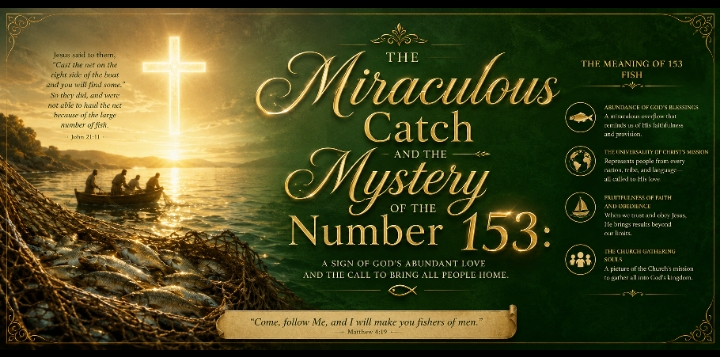
The account of the miraculous catch at the end of the Gospel of John is one of the most theologically and ecclesially dense texts in the Gospel. The scene is not limited to disciples who laboured at sea throughout the night and whose net was filled with fish at dawn. Rather, it opens onto a deeper symbolic structure: night and dawn, failure and fullness, hunger and table, water and net, word and Church, and a strange number that the text specifies with precision: one hundred and fifty-three fish.
This numerical detail, found in John 21:11, does not seem incidental. Instead of merely saying that the net was filled with many fish, the evangelist gives a precise number, and then adds that, despite such a quantity, the net was not torn. From here arises the theological question: is the number 153 merely the recollection of an eyewitness, or does it carry a biblical symbolic meaning? And if it does carry such a meaning, how can this meaning be read without falling into arbitrary numerical speculation?
This article proposes a reading that brings together three levels: the biblical level, especially the relationship between John 21 and Ezekiel 47; the theological level, grounded in love as the origin of new life; and the synesserational level, where the community of disciples is transformed from adjacent individuals into the Church becoming-in-relation in the Heart of Christ.
First: John 21 as a Resurrection Scene
The miraculous catch in John takes place after the Resurrection, and this detail is essential. Christ does not appear here in the context of His teaching before the Passion, but as the Risen One who rebuilds His relationship with His disciples after fear, denial, and dispersion. The disciples’ failure throughout the night is not merely a professional failure in fishing. It carries symbolic value: they are together in the boat, but they have not yet entered fully into the mission born of the Resurrection.
Before the word of Christ, they were fishing as individuals beside one another. The boat brought them together, but the mission had not yet united them. Their profession gathered them, but the communion of the Resurrection had not yet fused them into one. In this sense, their condition may be compared to the logic of coexistence, based on adjacency and the sharing of portions: a catch that could become booty to be divided, not a mission to be carried.
But the word of the Risen Christ changes the very nature of the act. When He says to them, “Cast the net on the right side of the boat, and you will find some,” He is not merely offering technical guidance to fishermen. He enters into their relationship with themselves, with one another, and with Himself. After the word, the net is no longer simply an instrument of individual or collective livelihood; it becomes the sign of an emerging Church. They now cast one net with one heart: the Heart of Christ.
From here we may say: before Christ, the catch was a number to be divided; after His word, the catch became a Church coming into being in His Heart.
Second: From Coexistence to Ecclesial Attaka’on
At this point, Attaka’on appears as a theological key for understanding the miraculous catch. The miracle does not consist only in the abundance of fish, nor simply in the filling of the net, but in the transformation of relationship: from individuals side by side in one boat to a Church becoming-in-relation in the Heart of Christ.
Before the word of Christ, the disciples were in a state of adjacency. They were together, but their “togetherness” had not yet reached the depth of communion. They resembled a group gathered by circumstances, work, fear, and fatigue, without yet becoming one apostolic “we.” But after the word of Christ, the boat became a place of ecclesial birth, the net was transformed from an instrument of fishing into a sign of mission, and the fish were transformed from a possible gain to be divided into a symbol of the multitude called to salvation.
Here, the self is not abolished, the other is not absorbed, and the multitude is not erased. Rather, all enter into a relationship that establishes unity without dissolution: a unity grounded in love, mission, and the higher reference. In the Gospel text, this higher reference is the Risen Christ, who becomes the Heart of the community and the source of its unity.
Ecclesial Attaka’on, in this scene, is the disciples’ passage from merely being together to becoming together in the Heart of Christ. For this reason, the net was not torn. It was no longer the net of adjacent individuals, but the net of a community that had begun to hear the word together, obey together, and carry the multitude together.
Third: The Question of Food and the Bond of Bread and Salt
The dialogue begins with Jesus’ question: “Children, have you any food?” At a superficial level, the question seems to concern the need for food. Yet in the Eastern and biblical context, food cannot be separated from relationship. The table does not express nourishment alone; it expresses covenant, intimacy, home, and fidelity. This is why the expression “bread and salt” carries, in Eastern memory, the meaning of a relationship that has entered the sphere of sacred loyalty and faithfulness.
From here, Christ does not ask for food because He is in need. Rather, He reopens the door of the table. The disciples, who had known disturbance, fear, and denial, need more than many fish; they need the re-establishment of relationship. The question of food thus becomes a relational act: the Risen Christ does not merely restore their fruitfulness; He restores them to the table of communion.
In this sense, love does not remain an abstract idea; it becomes a table. Divine love is not understood as a distant heavenly emotion, but as an act that draws near to human hunger, emptiness, and night, in order to transform them into a place of communion and life.
Fourth: The Right Side of the Boat and the Direction of Christ’s Heart
Christ’s command to cast the net on the right side of the boat deserves contemplative attention. The material difference between the right side and the left side of the boat may not be great in itself, and John does not seem to be teaching us a fishing technique. The right side may therefore be read symbolically: the side of the word, obedience, trust, and the passage from the calculations of exhausted experience to the logic of the Resurrection heart.
The image becomes deeper if we imagine Christ standing opposite them on the shore. When the other stands facing us, directions are reversed: our right corresponds to his left, and his left side, in bodily symbolism, is the side of the heart. Thus, in a contemplative sense, not as a strict geometric assertion, one may say that the right side of the boat, in the presence of Christ facing them, became the direction of His Heart.
In this sense, the disciples did not merely change the side from which they fished; they changed the direction of the heart: from their tired hearts to the Heart of Christ. From there the net was filled, not merely because the physical location had changed, but because the relationship had changed spiritually.
Fifth: The Number 153 between John and Ezekiel
The biblical reading of the number 153 finds important support in Ezekiel 47. In the prophet’s vision, water flows from the Temple toward the Dead Sea; its salty waters are healed, and the place of death becomes a place of life and abundant fish. The text mentions that fishermen shall stand from En-Gedi to En-Eglaim, that there will be a place for spreading nets, and that the fish will be exceedingly many.
In this context, the gematric observation appears¹: the word עגלים, that is, Eglaim, equals 153 according to the numerical value of Hebrew letters:
ע = 70
ג = 3
ל = 30
י = 10
ם = 40
The total is therefore: 153.
¹ Gematria is an ancient method of interpreting words according to the numerical values of their letters, especially in Hebrew and Greek. Each letter has a specific numerical value, and from the sum of these values a numerical meaning of the word may be derived. In this article, Gematria is not used to establish a doctrinal meaning in itself, but as a symbolic biblical indication that helps read the relationship between the number 153 in John 21 and the word “Eglaim” in Ezekiel 47, within the context of healed waters, fishermen, nets, and abundant fish.
A number of interpreters and scholars have pointed to the possible relationship between John 21 and Ezekiel 47, where the scene of healed waters, fishermen, nets, and abundant fish converges with John’s mention of the number 153 in the miraculous catch.
Yet methodological precision requires an important clarification: the number 153 does not equal, in Gematria, the word “love,” “charity,” or “the fullness of love” in a literal way. The direct gematric link is with Eglaim in the context of healed waters and abundant fishing. Reading the number as a sign of the fullness of love’s action is therefore a theological reading that arises from the biblical context, not from an artificial numerical equation.
Sixth: From the Dead Sea to Living Waters
If Ezekiel sees the waters flowing from the Temple healing the Dead Sea, John, in the light of the Resurrection, reveals the fulfilment of this vision in Christ. The One who stood on the shore of Tiberias is not merely a teacher offering advice; He is the Risen One who makes the waters a place of new life.
Here, the text of the Samaritan woman in John 4 becomes present, where Jesus says that whoever drinks of the water He gives will never thirst again. The Samaritan woman was not thirsty only for the water of the well, but for dignity, forgiveness, recognition, and a new beginning. Christ does not treat her as a closed moral case, but enters with her into a dialogue that liberates her and restores to her the possibility of mission.
From this perspective, John links water, life, and relationship. At the well of the Samaritan woman, living water heals the inner thirst of the human person. In the miraculous catch, the waters become a place of fruitfulness and mission. In Ezekiel, the Dead Sea itself becomes alive. The deepest bond is love: the waters do not become living by themselves, but because divine love passes through them and transforms them into a place of life.
Seventh: The Net That Was Not Torn and the Church Becoming-in-Relation in the Heart of Christ
John says that the net was filled with large fish, and yet it was not torn. This statement carries deep ecclesial meaning. The number is large, the fish are large, and the net, by its nature, is capable of being torn; nevertheless, it remains one.
Here the synesserational dimension of the text becomes visible. The net does not symbolize only the Church as a community that gathers the multitude; it symbolizes the pattern of relationship that makes the multitude bearable without division. If the logic of portions transforms the catch into booty, the logic of ecclesial love transforms it into mission. If coexistence keeps individuals adjacent to one another, communion in Christ makes them one body and one heart.
Thus, it may be said that love strengthened the weakness of the net. It did not abolish its weakness, but made it capable of carrying what it could not carry by its own strength. This is the mystery of the Church becoming-in-relation in the Heart of Christ: to carry the multitude without being torn, because it does not carry it by its own power, but by the power of the love that establishes it.
Eighth: Peter between the Emotion of the Water and the Love of the Heart
This reading is completed by recalling the scene of Peter walking on the water at Christ’s invitation. Peter left the boat with strong emotion, but it was an impetuous emotion before the wind. As soon as he became afraid, he began to sink. Yet Christ did not abandon him; He stretched out His hand and saved him.
In this scene, as in the miraculous catch, the waters cannot be understood alone. They may be a place of danger and drowning, or they may become a place of salvation when the hand of Christ is extended. What prevents the water from swallowing Peter is not Peter’s courage, but the love of Christ that does not leave him to drown.
Thus, the Samaritan woman, the disciples, and Peter stand side by side within one structure: inner thirst, nightly failure, fear before the wind. In all three cases, Christ comes to establish a saving relationship of love. Salvation is not offered merely as an external solution, but as a relationship that re-creates the human person and the community.
Conclusion: The Number 153 and the Sign of the Fullness of Love’s Action
The number 153 should therefore be read within a biblical and theological symbolic network. On the one hand, it is connected gematrically with Eglaim in Ezekiel 47, within the scene of healed waters, fishermen, nets, and abundant fish. On the other hand, in John 21, it acquires a Resurrection and ecclesial significance: it is the number of fullness that does not tear the net.
Yet theological reading takes the reflection one step further, without imposing on Gematria what it cannot bear. The number does not literally equal “love,” but in the light of Ezekiel and John it opens onto the meaning of the fullness of love’s action: the love that gives life to the waters, restores the dignity of the Samaritan woman, gathers the tired disciples, and transforms the catch from booty to be divided into a Church becoming-in-relation in the Heart of Christ.
The central conclusion may therefore be formulated as follows:
The number 153 is not a direct gematric equation for love, but a theological sign of the fullness of love’s action in the waters, the net, the table, and the Church becoming-in-relation in the Heart of Christ.
In this sense, the miraculous catch is no longer merely an extraordinary event, but an image of the new creation. The Risen Christ does not merely fill an empty net; He re-creates the community. He does not merely grant material abundance; He establishes a relationship. He does not merely transform water into life; He transforms the disciples from adjacent individuals into a Church capable of carrying the multitude without being torn, because it is no longer founded on the division of portions, but on the love that makes of the self and the other a “we” in the Heart of Christ.
Selected References
لا توجد تعليقات بعد.
آخر الأخبار
بين المشروعية التاريخية والهندسة الدستورية
بروفسور رزق زغيب
حول كتيّب "بين يَسوع وعِيسى : جسرٌ منيرٌ لا يمكن تجاهله"
الأب د. ميشال روحانا الأنطوني مبتكر مفهمة التكاؤن لغويُا وفلسفيًا

ذكرى استشهاد الرئيس القائد بشير الجميّل
الأب د. ميشال روحانا الأنطوني مبتكر مفهمة التكاؤن لغويُا وفلسفيًا
اليوم العالمي للسلام
خلود وتار قاسم
المكون اللبناني الشيعي
الأب د. ميشال روحانا الأنطوني مبتكر مفهمة التكاؤن لغويُا وفلسفيًا
لا تصعد السمكة على الشجرة
رشيد درباس
Attaka’on Between Foundational Integrity and Instrumentalization
Rev. Michel Rouhana, PhD, Antonine Order
التكاؤُن بين التأسيس والاستعمال
الأب د. ميشال روحانا الأنطوني مبتكر مفهمة التكاؤن لغويُا وفلسفيًا
الخلق من الحب وليس من العدم: جسرٌ منيرٌ بين العِلم والدين
البروفسور جهاد نعمان
Copyrights © 2025 All Rights Reserved. | Powered by OSITCOM